
Skip to content
All About Carboys — Innovating A Classic Lab Container

All About Carboys — Innovating A Classic Lab Container

A brief look inside any biology or chemistry lab will typically display a myriad of lab supplies. Flasks, Beakers, Petri Dishes, Test Tubes, Charts, Scientific Instruments, Sinks/Washing Stations, and other laboratory equipment will most likely line the walls, clutter benchtops, and otherwise take up valuable lab space. Among the scientific apparatus, you will undoubtedly find a carboy. 

Although a humble container, carboys are known to be one of the most indispensable assets to scientists and researchers. Liquid storage, and the transportation of media, is a consistent need in the science field. With multi-purposes, laboratory carboys are able to contain nearly any fluid and are the quintessential storage container when working with large volumes of liquid. 

Primarily made of glass or plastic, carboys are available to suit different purposes. Some feature the ability to be autoclaved, while others can withstand certain levels of heat, cold, or chemical interactions. Carboys have come a long way from their humble beginnings, and many strides have been made to innovate their designs. 

Plastic Carboys

Many plastic carboys tend to be made of PETG (polyethylene terephthalate, glycol-modified). These are typically cheaper than glass carboys and more lightweight. The lightweight nature of plastic makes it the superior option in cases where heavy-duty loading equipment isn't easily accessible and mobility is a necessity. An empty glass carboy can still be difficult to maneuver, whereas plastic carboys can be handled with ease.

Plastic carboys are also more modular than glass ones. One could easily drill a hole, add spigots, or any other functionality without compromising the integrity of the material or containment.  

Plastic is not intended for use with all materials and media, however, as certain liquids can stain the plastic lining, leaving odors or stains difficult to remove. Additionally, if a carboy was not made with BPA-Free material, it can possibly affect the taste and cause potential health risks if you are storing liquid intended for consumption like beer or wine. 

Glass Carboys

Glass carboys are a great choice where long term storage and minimal transportation are needed. Often quite heavier, glass carboys are easier to clean than plastic due to the slick nature of glass. Oxygen and other gasses are not able to easily penetrate glass, so contents are able to maintain freshness and sterility if capped. Glass is also a more durable material than plastic, unable to be to easily scratch. 

There are some potential risks with glass to be aware of. While sturdy and durable, glass is able to be shattered with large enough impact. Turbulent conditions or dropping from even small heights can yield disaster if a glass carboy shatters. Additionally, glass carboys can become very heavy when filled. 

Foxx Life Sciences Carboys 

While the carboy, as it existed for hundreds of years has worked fine, we here at Foxx Life Sciences have worked to improve its design and grant greater functionality and ease-of-use to researchers across the globe. We are proud to boast the widest selection of sizes on the market, from 2.5 liters (.5 gallons) to 75 liters (20 gallons). The improvements we've made are extensive.


We expanded the variety of materials carboys are made of. In addition to glass and PETG, we manufacture PP (polypropylene), HDPE (high-density polyethylene resin), and PC (polycarbonate). Assembled in our ISO 7 cleanroom, all of our laboratory and bioprocess carboys are BPA-free and made from USP Class VI and FDA grade materials, gamma sterilized in the United States. 

Carboy Innovations

To improve carboys, we reduced and altered the profile of the carboy while maintaining volume. The distinct rectangular shape now saves valuable lab and bench space, allowing easy stacking and storage. Cylindrical carboys can unintentionally roll on your bench, wreaking havoc and potentially breaking if they hit the ground. Our efficient design eliminates this possibility. Our researchers at sea really love us! 

Additionally, we added ergonomic handles on all of our models to allow easy maneuverability and transportation. This means safer handling, easier pouring, and greater versatility. Molded grips in the base are strategically placed to allow easy lifting from below.
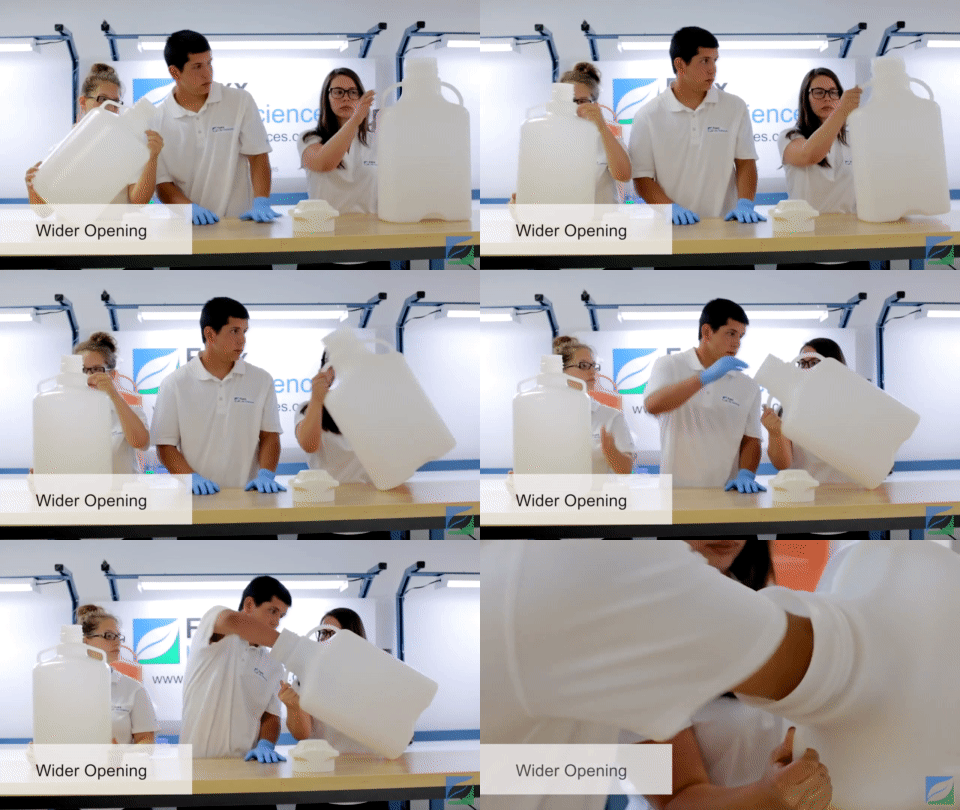
Foxx Life Sciences Carboy Opening

We widened the neck of the carboy to enable faster pouring and to simplify cleaning. Hard to clean spots are now literally in reach, as you can fit your entire arm inside of the carboy. The largemouth on the carboy means trivial fluid transfer without the need for funnels.

We placed the spigot inset to the carboy, reducing the profile and minimizing the chance for accidental bumps with the spigot. Our carboy spigots utilize our VersaBarb technology, which allows for a variety of different spigot sizes, dual flow rates, and secure locking to prevent leakage. 

We imprinted large, easy-to-read metric graduation marks on the outside of the carboy, certified to ±5% accuracy. The carboy material and volume are also imprinted.

Finally, we fitted our carboys with our VersaCap technology to enable even broader functionality and flexibility. From microbiology to chemistry, to brewing craft beer at home, our carboys can do it all. 

Economical in both wallet and storage, our carboys are a must-have for any laboratory. 

Innovation is our driving force here at Foxx. The changes we've made to even the simplest of lab equipment demonstrates our dedication to improving lab safety and quality across the world. Our Innovation is Your Opportunity and we trust our carboys would be an excellent addition to any laboratory, regardless of size. 

We've even created some documentation to make carboy lifting/handling and carboy cleaning easier.

Carboy Care - How to Lift and Clean Carboys

Carboy Lifting Tips by Foxx Life Sciences

Carboy Lifting Instructions from Foxx Life Sciences

Carboy Cleaning Tips by Foxx Life Sciences


Previous article Foxx Life Sciences' First Company Picnic!
Next article State of the Art White Room Launched in Hyderabad

Frequently Asked Questions

Foxx filtration products, including membrane filters and vacuum filtration assemblies, are used to remove particulates, sterilize media, and prepare solutions for cell culture or analytical processes, offering high-performance separation suitable for diverse laboratory needs.
VersaCap® is a patented leak-proof cap technology used on carboys and bottles that supports interchangeable connectors, secure venting, and reliable attachment of tubing and filters. It enhances fluid management flexibility for bioprocess and lab applications without compromising sterility or workflow integrity.
Foxx carboys are designed with wide necks, clear graduations, and space-saving shapes that make filling, handling, and storage easier while providing accurate volume measures and secure closures important for busy labs managing media, reagents, or waste solutions.
Delivery timelines for products ordered on foxxlifesciences.in vary based on location and availability, but the company aims for fast processing and regional distribution through its Hyderabad facility to support timely supply to labs and manufacturers in India and the APAC region.
Industries including biotechnology, pharmaceutical manufacturing, clinical research, vaccine production, and laboratory research rely on Foxx single-use systems for sterile fluid transfer, media storage, waste containment, filtration, and advanced bioprocess workflows due to their regulatory compliance and ease of use.
Yes. Using single-use bottle assemblies and carboys with integrated tubing, vent filters, and leak-proof cap systems helps establish closed fluid paths that lower contamination risk compared to reusable glass or open systems, improving overall process integrity in research and biomanufacturing.
When selecting tubing and connectors, consider chemical compatibility, sterility requirements, flow rate needs, and connection type (such as hose barb or aseptic connectors). Foxx provides options in silicone, thermoplastic (TPE), and multiple connector standards to meet fluid handling performance in bioprocess applications.
Foxx offers custom single-use assemblies (MTO) where customers can choose specific bottle sizes, tubing brands, connectors, and configurations designed to match project requirements. These tailored systems are ideal for specialized bioprocessing, fluid management, or unique lab workflows that need bespoke solutions.
Sterile assemblies are gamma irradiated and sealed to minimize contamination risks, making them ready for use in sensitive bioprocess and cell culture workflows. Non-sterile assemblies still offer the same high-quality materials and design but require in-house sterilization or cleaning prior to use depending on your lab protocol.
Foxx Life Sciences offers single-use bottle assemblies in various capacities, from small media bottles to larger assemblies tailored for culture, formulation, or waste applications. These are constructed with USP Class VI resins and may include tubing, filtration, and VersaCap® systems to support aseptic fluid transfer in lab workflows.
Foxx carboys, including EZBio® and EZGrip® models, are designed with ergonomic handles, secure VersaCap® leak-proof technology, and USP Class VI materials to provide safe, efficient fluid storage and transfer. Their shape, graduations, and connector options make them versatile for liquid handling, media storage, waste collection, and integration with single-use systems.
Yes. Foxx Life Sciences products are developed using USP Class VI materials and FDA-grade components, produced in ISO Class 7 certified environments, and supported by QA documentation. This compliance ensures that the products meet rigorous performance, sterility, and quality requirements for life science, biopharma, and laboratory applications.
Choosing Foxx Life Sciences gives you access to high-quality single-use bioprocess products manufactured under ISO 13485 quality standards, assembled in cleanroom environments, and backed by global experience in fluid management and lab consumables. Their solutions help labs and manufacturers achieve reliable performance, regulatory compliance, and optimized process workflows from research through full-scale production.
Single-Use Technology (SUT) refers to disposable fluid handling and consumable systems that eliminate the need for cleaning and sterilization validation, improve contamination control, reduce turnaround time, and lower operational costs. SUT is widely adopted in biopharmaceutical manufacturing, vaccine development, and laboratory research because it allows faster setup, minimal cross-contamination risk, and scalable process efficiency.
Foxx Life Sciences provides a comprehensive range of laboratory and bioprocess consumables including single-use systems (SUS), bottle and carboy assemblies, filtration products, tubing and connectors, collars and gaskets, stainless steel options, and custom assemblies designed to meet the needs of research labs, biotech manufacturers, and pharmaceutical production facilities. These products are engineered to support fluid handling, sterile storage, and efficient workflows across upstream and downstream bioprocessing operations.